What adapted social housing means in France
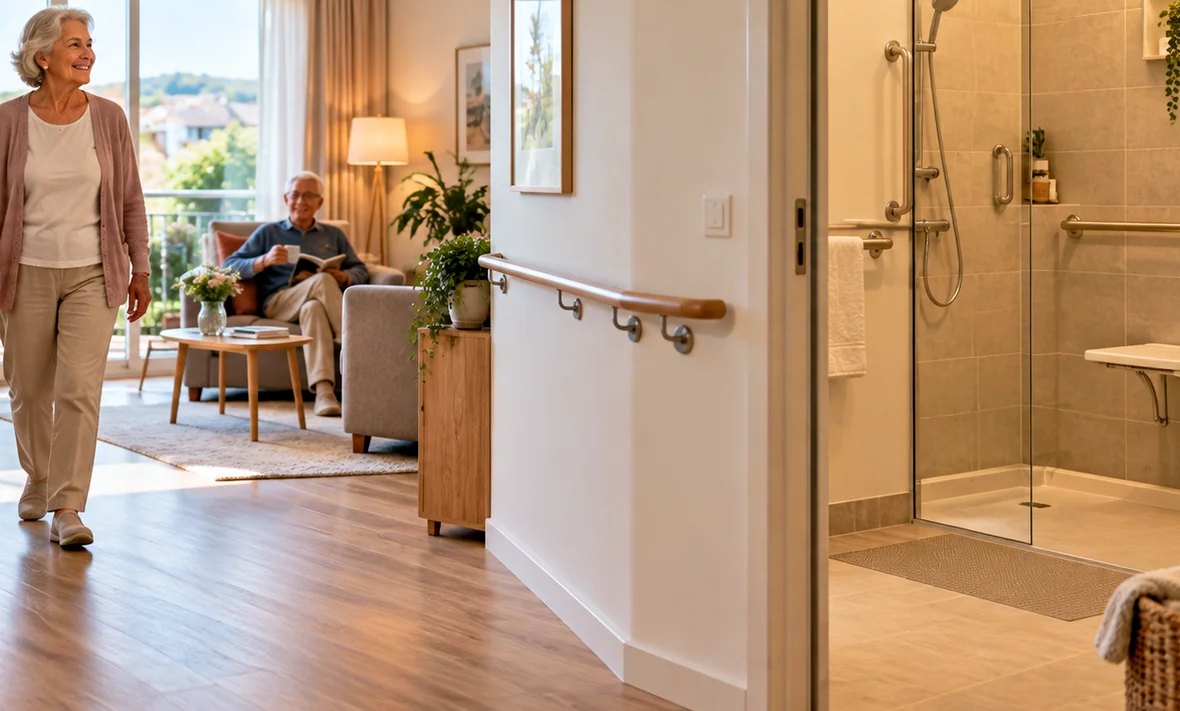
Social housing, often called HLM, consists of rental homes owned by social landlords and let at regulated rents to households under income ceilings. Adapted units add accessible bathrooms, step-free access, grab rails or lifts, making them suitable for older tenants with reduced mobility.
Some landlords also create small groups of senior-friendly flats within ordinary buildings, sometimes with a shared room or a visiting coordinator. Independent-living residences managed by municipal social centres, called résidences autonomie, form a related category with collective services and moderate fees.
Who these homes are intended for
Eligible applicants are households whose income lies below national ceilings, which depend on household size and location. Older people living in unsuitable, inaccessible or overly large homes are often considered in allocation decisions, as are people with a recognised disability.
Foreign nationals may apply if they hold a valid residence permit or have the right to reside as citizens of the European Union. Applications without lawful residence are not accepted, so newcomers must regularise their status before registering a request.
How allocation works
Each application receives a unique registration number, valid for one year and renewable. Allocation committees within social landlords examine candidates for available homes, taking into account priority criteria, household composition, income and the suitability of the dwelling for the applicant.
Recent articles from the Banque des Territoires describe how social landlords, local authorities and funders are working to adapt more homes for an ageing population. Adaptation may cover existing flats as well as new buildings designed for senior tenants.
Rents, charges and housing aid
Rents are regulated and generally lower than in the private market, though service charges for heating, lifts and maintenance are added. Tenants on modest incomes may receive personalised housing aid, the APL, paid by the family allowance fund, the CAF.
The table compares adapted social flats with other common forms of housing for older people in France. Costs and services differ considerably, so the right choice depends on income, level of autonomy and the need for collective activities or medical supervision.
| Option | Who manages it | Typical features |
|---|---|---|
| Adapted HLM flat | Social landlord | Regulated rent, accessible design, APL possible |
| Résidence autonomie | Municipal social centre or association | Private flat plus collective services |
| Private senior residence | Commercial operator | Services package, higher monthly costs |
| Nursing home (EHPAD) | Public, associative or private | Medical care for dependent residents |
Applying step by step
The procedure is the same throughout France and can be completed online or on a paper form. Supporting documents must be supplied, and applicants should update their file whenever circumstances change, such as a hospital stay or increasing mobility problems.
- Check that household income is below the applicable ceiling
- Register online or submit the national application form
- Indicate the need for an adapted dwelling and mobility limitations
- Provide identity, residence permit and tax documents
- Renew the request each year until an offer is made
- Apply for housing aid from the CAF after signing the lease
Equivalents in English-speaking countries
In the United Kingdom, councils and housing associations let sheltered housing to older people, often with an alarm and scheme manager. Ireland has local authority and approved housing body accommodation for older people, sometimes grouped near town centres.
In the United States, the federal Section 202 programme supports affordable housing with services for low-income older adults. Canada and Australia also offer social or community housing for seniors, managed by provinces, states or non-profit organisations under local eligibility rules.
Accessing the French model from abroad
Applicants living outside France may register a request, but they must meet residence conditions when the home is allocated. Retirees moving to France should therefore organise their residence status and income documentation early, since waiting times in large cities can be long.
Pension statements, tax notices and proof of resources may need translation into French. Retirees arriving from the United Kingdom or North America often find that renting privately for a first period simplifies registration, tax filing and the opening of a French bank account.
Pitfalls to watch for
Several practical difficulties recur among older applicants, particularly among those who are unfamiliar with French administration. Being aware of them helps prevent rejected applications or offers that do not suit a person’s mobility and long-term needs.
- Forgetting to renew the application each year
- Not stating mobility needs clearly in the request
- Refusing offers without valid reasons, which may affect priority
- Overlooking service charges when comparing rents
- Applying before obtaining a valid residence permit
Can a retired foreigner obtain an HLM flat?
Yes, provided the person resides lawfully in France and meets income ceilings. Citizens of the European Union and holders of residence permits are treated like French applicants, while allocation depends on supply, priority criteria and local demand.
Is the APL available to senior tenants?
Housing aid can be granted to tenants of social housing according to income, rent and household composition. The CAF or the agricultural social insurance fund handles applications, and amounts are recalculated periodically based on recent resources.
How long is the wait?
Waiting times vary greatly by area. In major cities they may extend over several years, whereas smaller towns can offer homes more quickly. Flexibility on location and type of dwelling often improves the chances of receiving an offer.
Do adapted homes include care services?
Adapted social flats provide accessible housing but not personal care. Tenants can arrange home-care services separately and may request the APA allowance if they lose autonomy, which helps finance help at home in ordinary housing.
Sources and organisations
- Banque des Territoires – Adaptation au vieillissement des bailleurs sociaux — Article, in French, on how social landlords, local authorities and funders adapt social housing for an ageing population.
- CAF – Les aides que la Caf peut verser en maison de retraite — Official CAF page, in French, on housing allowances such as APL and ALS for older people in residences.
- Changer de logement – résidences autonomie et solutions — Official French portal section presenting housing options for older people, including independent-living residences and shared housing.