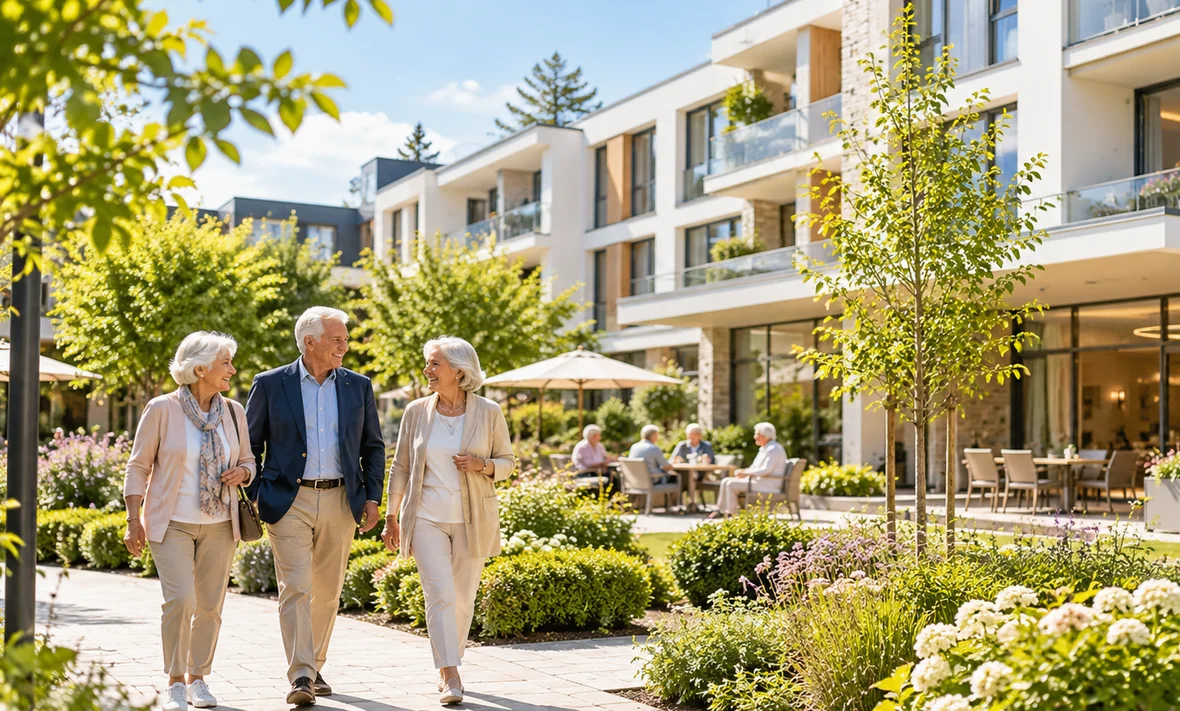
Senior housing options in Ecuador
Most foreign retirees live independently in rented or purchased apartments, colonial houses or small farms. Cuenca's modern apartment towers along the river, often with doormen and lifts, have become a recognisable feature of the expatriate retirement scene over the past two decades.
For people needing care, Ecuador has gerontological centres, private residences for older adults and day centres. Many are small, family-run and Spanish-speaking. A few private residences in Cuenca, Quito and Guayaquil target foreigners, but capacity remains limited compared with demand.
Who provides care
The Ministry of Economic and Social Inclusion, MIES, sets standards for services for older people and funds programmes for vulnerable citizens. Private operators, religious organisations and foundations run most residences. Requesting proof of registration and asking about staff training gives an initial picture of quality.
Home care is affordable and commonly used. Families hire caregivers directly or through agencies, and nurses can visit for injections or wound care. As in other countries, direct employment brings obligations under labour and social security law that should be respected.
The retiree residence visa
Ecuador offers a temporary residence visa for retirees who can prove a stable lifetime pension above a minimum amount linked to the national basic wage. Applications are handled by the foreign ministry, with apostilled and translated documents and proof of health insurance.
After temporary residence, holders may apply for permanent residence under conditions set by law. Time spent outside the country during the temporary period can affect eligibility, so retirees who travel often should read the rules carefully before planning long trips.
Healthcare and insurance
Residents can affiliate voluntarily with IESS, the social security institute, which provides access to its hospitals and clinics after paying monthly contributions. Many retirees combine IESS with private insurance or pay directly at private clinics, where fees are moderate by North American standards.
Quito, Guayaquil and Cuenca offer good private hospitals and specialists. Smaller towns like Cotacachi or Vilcabamba have basic services, so residents travel to larger cities for tests and treatment. Proximity to a hospital becomes more important with age.
Cost of living
The dollar economy removes exchange-rate risk for American retirees, while others still face fluctuations. Local food, public transport and services are inexpensive, though imported goods and cars are costly because of duties. Housing prices differ between expatriate districts and local neighbourhoods.
Utilities are generally modest, especially in the highlands where heating and cooling are rarely needed. On the coast, air-conditioning raises electricity bills. Property taxes are low, but buyers must budget for notary, registration and legal fees at purchase.
Regions and climate
- Cuenca: mild Andean climate, colonial centre, large expatriate community.
- Quito: capital with full services, at very high altitude.
- Cotacachi and Otavalo: small highland towns with markets and mountain views.
- Salinas and the Pacific coast: beaches, warmth and seafood.
Altitude is a major consideration. Quito and Cuenca lie well above 2,000 metres, which some older people with heart or lung conditions find difficult. Medical advice before relocating, and a trial stay of several weeks, are prudent.
Community networks are strong. In Cuenca especially, expatriate groups organise social events, share recommendations for doctors and lawyers, and help newcomers with paperwork. These networks can also connect older residents with volunteers when family lives far away.
Options compared
| Option | Profile | Typical place | Check |
|---|---|---|---|
| Apartment with doorman | Independent couples | Cuenca, Quito | Lift, earthquake standards |
| House or small farm | Nature lovers | Highland valleys | Distance to hospital |
| Private residence | Care needs | Major cities | Registration, language |
| Home caregiver | Ageing at home | Any location | Contract, social security |
When comparing residences, look beyond the room itself. Ask how many residents share a caregiver at night, whether a doctor visits regularly, what meals are served and how families are informed when health changes or a hospital transfer becomes necessary.
Steps to relocate
- Visit Cuenca, Quito and the coast, staying at least a few weeks.
- Obtain a pension certificate, criminal record check and apostilled documents.
- Apply for the retiree temporary residence visa with health insurance.
- Obtain an Ecuadorian identity card after the visa is granted.
- Affiliate with IESS or confirm private cover, then sign a long-term lease.
Pitfalls and contract checks
Leases should be written, registered where required and specify deposits, maintenance and who pays building fees. Property purchases demand a title search at the property registry. Informal agreements, common in rural areas, offer little protection if a dispute arises.
- Moving to high altitude without medical advice.
- Relying solely on a single caregiver without backup.
- Assuming visa rules never change.
- Forgetting to check whether your state pension is uprated while living in Ecuador.
Is Spanish essential in Ecuador?
In Cuenca and some coastal towns, English-speaking services exist for expatriates, but daily life, medical care and bureaucracy happen mostly in Spanish. Basic Spanish greatly improves safety, independence and integration with neighbours, and local schools offer affordable lessons.
Can retirees use the public health system?
Legal residents can join IESS voluntarily, paying monthly contributions. Rules on waiting periods and pre-existing conditions should be checked at affiliation. Many retirees keep private cover for faster appointments, broader choice of doctor and treatment in private clinics.
Is Ecuador prone to earthquakes?
Yes, the country is seismically active. Modern buildings in major cities are designed with seismic standards, but older and informal constructions may not be. Asking about construction dates and building permits is a reasonable precaution.
How does the dollar affect retirees?
Ecuador's official currency is the US dollar. Retirees receiving dollar pensions avoid exchange risk entirely. Those paid in euros, pounds or Canadian dollars should budget for fluctuations, keeping a cash reserve to absorb weaker periods without cutting essential spending.
Sources and organisations
- gob.ec – Visa de residencia temporal jubilado — Official Ecuadorian government procedure for the retiree temporary residence visa, detailing requirements, fees and application steps.