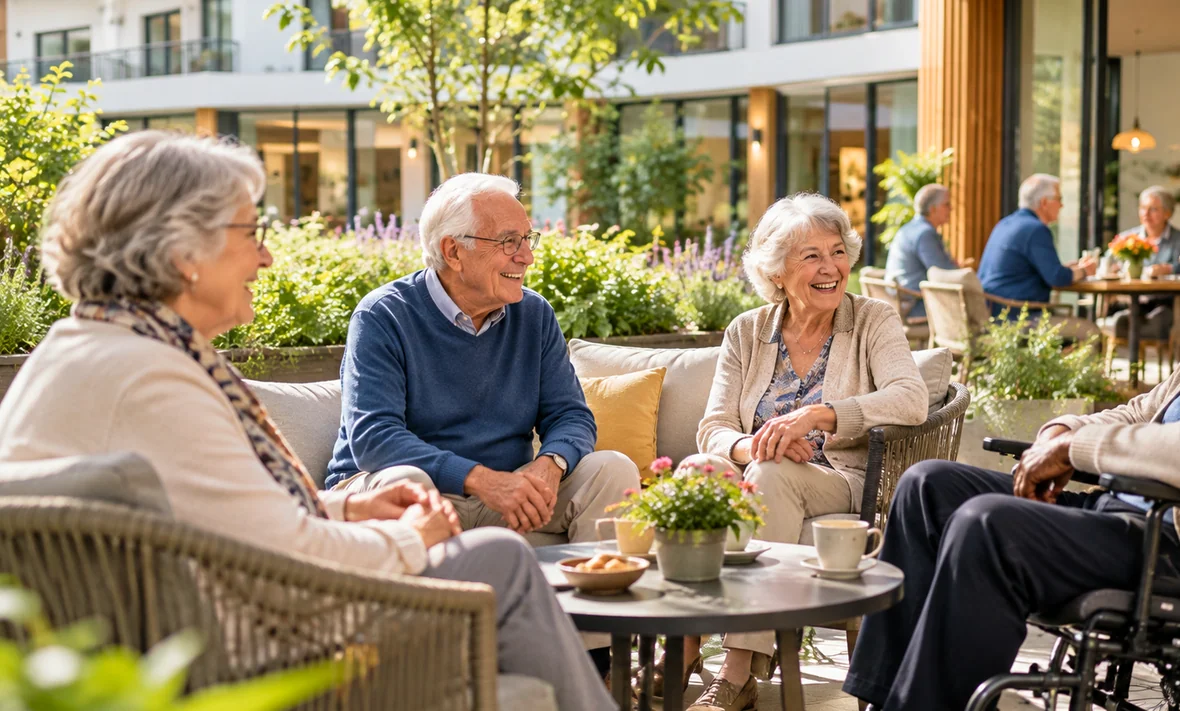
What a shared senior house actually is
In France the idea appears under several names: maison partagée, colocation seniors and, since the ELAN housing law of 2018, habitat inclusif. Each resident signs an individual lease or occupancy agreement and remains legally at home, not in an institution.
The group is usually small, often fewer than ten people, so decisions about meals, outings and house rules are taken together. Personal care is not provided by the house itself; residents call on home-help services, district nurses or relatives exactly as in an ordinary flat.
Who chooses this way of living
The formula suits older people who are largely independent but isolated, find a family home too large, or want company without the rhythm of a collective establishment. Some projects welcome people with disabilities alongside retirees, which is the inclusive dimension promoted by public policy.
It also attracts couples whose partners have different needs, widowed people reluctant to live alone, and retirees returning to France after years abroad who no longer have a network nearby. A shared house offers neighbours who notice when something is wrong.
How the organisation works day to day
A landlord, often a social housing body, an association or a mutual insurer, provides the building and adapts it for ageing: step-free access, walk-in showers, wide doorways. A coordinator or house facilitator may organise the shared life project and liaise with nurses and care services.
| Feature | Shared senior house | Serviced residence | Nursing home (EHPAD) |
|---|---|---|---|
| Size | A handful of residents | Dozens of flats | Often 60 to 100 beds |
| Status of resident | Tenant at home | Tenant or owner | Resident of an institution |
| Care on site | None, outside services come in | None, optional services | Nursing and medical coordination |
| Social life | Shared project decided together | Activities programme | Organised by staff |
| Typical funding help | Housing aid, APA at home, shared-living allowance | Housing aid, APA at home | APA in establishment, ASH, housing aid |
Paying for a place and the aids available
Residents pay rent and service charges, plus a share of food and household costs. Where a département has signed an agreement, a shared-living allowance (aide à la vie partagée) can fund the coordinator. Housing benefit and the home-based APA autonomy allowance may also apply.
- Clarify your needs today and in five years, including mobility and nursing
- Ask the local council, the département or a CLIC information point which projects exist
- Visit the house, meet the residents and read the shared life charter
- Check the lease, the service contract and the rules for leaving
- Apply for housing benefit and, if eligible, for APA before moving in
Equivalents in English-speaking countries
In the United Kingdom the closest model is the Abbeyfield-style supported house, where a small group of older tenants share meals under a house coordinator. Senior cohousing communities, built around private homes and a common house, are another British option with a similar spirit.
North American readers will recognise home-sharing arrangements, sometimes nicknamed Golden Girls living, where unrelated retirees rent a house together. Australia and Canada also have cohousing groups. In each case the legal framework is tenancy law rather than care-home regulation, as in France.
Can a foreign retiree join a French shared house
A citizen of the European Union can settle in France freely and rent like anyone else. Retirees from the United Kingdom, the United States, Canada or Australia generally need a long-stay visa and then a residence permit, usually showing sufficient income and health insurance.
Access to French aids is more restrictive. The APA autonomy allowance requires stable and regular residence in France, and housing benefit depends on legal residence and income. A retiree moving from abroad should therefore budget without aid for the first months.
Pitfalls to avoid before signing
- Assuming that care is included when the house only provides housing and a coordinator
- Signing without meeting the other residents and testing the atmosphere over several visits
- Overlooking how the house reacts if your dependency increases sharply
- Ignoring the notice period and the conditions for recovering your deposit
- Choosing a remote rural house without checking access to doctors and transport
Frequently asked questions
The questions below are those most often raised by families and by retirees carefully comparing a shared house with a serviced residence, a small care unit or remaining in their own home with outside help.
Is a shared senior house the same as a care home?
No. Residents keep the legal status of tenants living at home, choose their own doctors and home-care providers, and are not supervised by a medical team. A care home, by contrast, is a regulated establishment with nursing staff present around the clock.
What happens if one resident becomes very dependent?
Extra home care can often be added, financed partly by APA. When needs exceed what visiting professionals can safely provide, the resident, the family and the coordinator usually look together for a nursing home or a specialised unit nearby.
Can I bring my own furniture?
In most projects the private room or studio is furnished by the resident, which helps people feel at home. Shared areas are usually equipped by the landlord or the association, and any personal items placed there are agreed with the group.
How do I find a shared house in France?
Start with the official portal for older people, the local social services of the town hall and the département. Social landlords, mutual insurers and associations running inclusive housing also publish vacancies, and waiting lists are common in popular towns.
Sources and organisations
- Habitat inclusif : un chez-soi et une vie sociale partagée — Official page on inclusive housing: private home with shared spaces, a shared social-life project and the shared-living allowance.
- La Banque Postale – La colocation intergénérationnelle — Guide to intergenerational house-sharing: a senior rents a room to a young person, legal framework, contract and mutual benefits.
- SeLoger – Béguinage et habitat inclusif — Article explaining béguinage and inclusive housing: clustered small homes, mutual support among senior neighbours and often moderate rents.